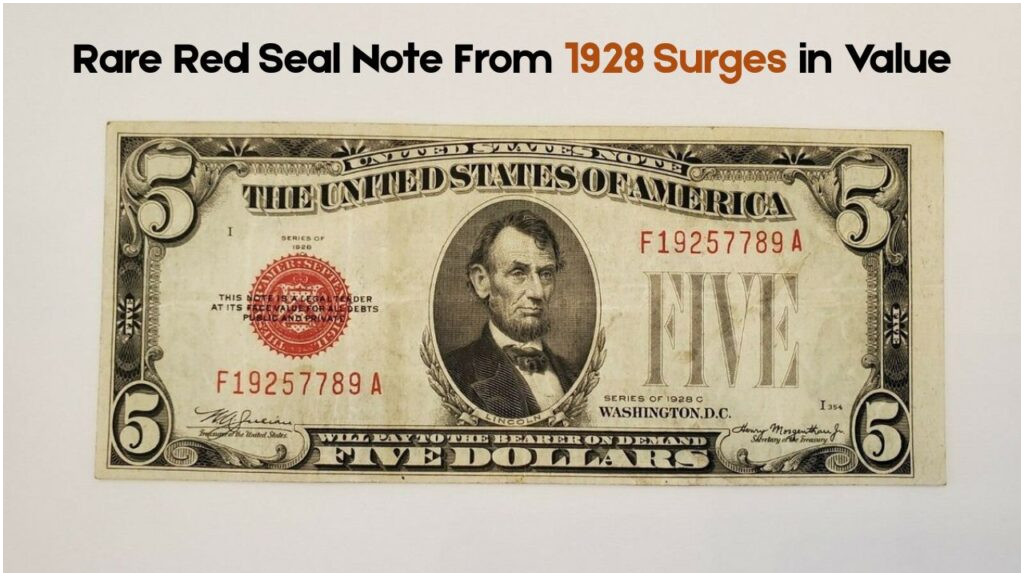
1928 Red Seal $5 Bill – In the world of currency collecting, few bills have made as much of a buzz in recent times as the 1928 Red Seal $5 Bill. Once a simple legal tender note in everyday circulation, this old paper bill has now become a hot commodity among collectors, numismatists, and antique investors alike. As of August 2025, this bill is back in the spotlight — and some versions are now selling for over $6,500, making it more valuable than the average monthly salary in the U.S.!
What Makes the 1928 Red Seal $5 Bill So Special?
The 1928 series was the first U.S. currency to bear the small-sized format that we still use today. But beyond size, it holds multiple historic and collectible traits:
- Red Seal & Serial Numbers: Unlike modern green-seal notes, this one has a bold red Treasury seal and matching red serial numbers.
- United States Note: Unlike Federal Reserve Notes, it is labeled as a United States Note, which were once issued directly by the Treasury.
- Historic Context: These notes were issued during the Great Depression, a time of massive economic hardship, which makes them historically significant.
All these factors combined give the 1928 Red Seal $5 Bill an edge in rarity, demand, and ultimately – price.
Current Market Value: How Much Is It Worth in 2025?
Here’s a breakdown of what collectors are paying for different conditions of the 1928 Red Seal $5 Bill as of August 2025:
| Condition | Approx. Value (USD) | Key Features |
|---|---|---|
| Very Fine (VF) | $90 – $150 | Slight wear, red seal clear, creases visible |
| Extra Fine (EF) | $150 – $300 | Crisp feel, minimal folds, great edges |
| About Uncirculated (AU) | $350 – $600 | Almost mint, barely handled |
| Crisp Uncirculated (CU) | $800 – $1,200 | No folds, sharp print, collector-grade |
| Star Note or Rare Serial | $2,000 – $6,500+ | Low serials, star replacements, misprints |
Note: The value spikes dramatically for rare variants, such as:
- Low serial numbers (like 00000012)
- Star Notes (denoted with a ★)
- Errors (misprints, double seals, etc.)
Why Is It Trending Again in 2025?
The renewed interest in the 1928 Red Seal $5 Bill isn’t random — it’s fueled by a mix of economic trends and viral online content.
1. Inflation & Gold Investors Turning to Paper Currency
As inflation impacts real-world purchasing power, alternative investments like gold, crypto, and rare currency are gaining traction. This bill is now seen not only as a collectible but also as a hedge against inflation.
2. Social Media Hype
In July 2025, multiple TikTok and YouTube influencers in the finance and collectibles space showcased rare Red Seal bills that sold for thousands at auctions. One video featuring a pristine 1928 Red Seal with serial #000013 sold for $5,700, sparking massive searches and demand.
3. Generational Wealth & Inherited Collections
Many Americans are inheriting old currency from grandparents. As they explore the value of these notes, the 1928 Red Seal is being rediscovered across estates and attics — leading to a wave of appraisals and online listings.
How to Identify an Authentic 1928 Red Seal $5 Bill
Use this quick checklist to verify if your bill is authentic and valuable:
- Look for the Red Seal and Serial Numbers
- Check the Date: Must say ‘Series of 1928’
- Signatures: Look for the printed signatures of Treasurer of the United States and Secretary of the Treasury
- Small Size Format: Measures approx. 6.14 x 2.61 inches (not the large-size notes from 1914 and earlier)
- Bonus Points: Star Note or rare serial numbers? Jackpot!
If you find one matching these criteria, especially in good condition, don’t spend it! It’s likely worth far more than face value.
What to Do If You Own One
If you suspect you have a 1928 Red Seal $5 Bill, follow these steps:
1. Preserve It
Avoid folding it further or handling it too much. Place it in a currency sleeve or a zip-lock bag with minimal air exposure.
2. Get It Appraised
Contact a certified currency appraiser or send it to grading companies like PCGS Currency or PMG for professional evaluation.
3. Sell It Smartly
- Consider auction houses like Heritage Auctions or Stacks Bowers.
- List on eBay, but make sure it’s professionally graded to build buyer confidence.
- Use forums like Collectible Currency Forums or Reddit’s r/papermoney.
Fun Fact: What Was $5 Worth in 1928?
Back in 1928, $5 was equivalent to over $85 today in purchasing power. That means owning this bill not only preserves historical cash value but can now 10x or even 100x your investment depending on condition!
As inflation rises and collectibles gain momentum, the 1928 Red Seal $5 Bill proves that old money can turn into serious new cash. Whether found in an attic, passed down in a family Bible, or bought years ago at a garage sale — these bills are no longer just paper, they’re treasure.
FAQs About the 1928 Red Seal $5 Bill
1. What does the red seal mean on a $5 bill?
It signifies that the note is a United States Note, issued directly by the Treasury, not the Federal Reserve.
2. How rare is the 1928 Red Seal $5 bill?
While not the rarest, bills in mint condition or with star notes or errors are considered highly collectible and scarce.
3. Can I still spend a 1928 Red Seal $5 bill at face value?
Yes, it’s technically legal tender — but spending it for $5 would be a huge loss!
4. How do I know if my note is a “Star Note”?
Check the serial number. If it ends (or begins) with a ★ instead of a letter, it’s a star replacement note — and can be worth much more.
5. Where can I sell my 1928 Red Seal $5 bill?
You can sell it via currency auction houses, eBay (preferably graded), or to private collectors through online forums.
Why is the 1928 Red Seal $5 bill trending and valuable?
Due to rarity and collectors' interest, increasing its value.
How has the value of the 1928 Red Seal $5 bill increased?
Demand and rarity drove its worth above average monthly salary.
What factors have contributed to the increased worth of the 1928 Red Seal $5 bill?
Historical significance, rarity, and demand drive its value surge.
What makes the 1928 Red Seal $5 bill valuable and sought after?
Its historical significance and limited availability drive its increasing worth.