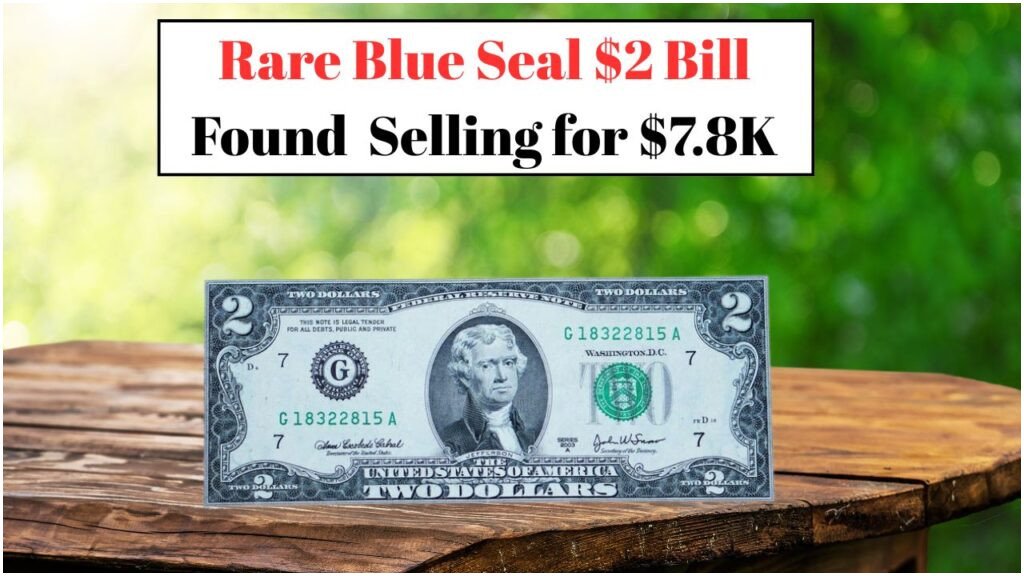
$2 Bill With Blue Seal – In the world of rare currency collecting, sometimes the smallest-looking items can bring the biggest surprises. One such hidden gem is a special $2 bill from the World War II era – identified by its blue seal. At first glance, it may look like an ordinary note, but to seasoned collectors, it holds tremendous value. In fact, some specimens of this $2 bill have fetched up to $7,800 at auctions in the U.S. If you’re wondering whether the old $2 bill lying in your drawer could be one of these rare treasures, this detailed guide is for you. From understanding what makes this bill valuable to knowing how to identify a real one – let’s explore everything you need to know about the WWII-era blue seal $2 bill.
What Is the WWII-Era $2 Bill With Blue Seal?
During World War II, the U.S. government printed a variety of banknotes with colored seals to distinguish emergency issues and war-related financial moves. One such note was the $2 bill featuring a blue treasury seal.
Key Identification Features:
- Printed between 1942 and 1945
- Bears a blue seal (instead of the usual red for $2 bills)
- Labeled as a Silver Certificate
- Typically marked with series 1935 or 1953
- Features a portrait of Thomas Jefferson
Why Is the Blue Seal $2 Bill So Valuable?
While most $2 bills are only worth face value or slightly more, the WWII-era blue seal versions are much rarer.
Factors that contribute to high value:
- Limited print run during wartime
- Unique color variation (blue seal vs red seal)
- Historical context related to WWII
- Silver Certificate classification
- Scarcity in high-grade condition
Collectors are willing to pay thousands for uncirculated or low-serial-number bills, especially those with no folds, marks, or tears.
How to Identify an Authentic WWII Blue Seal $2 Bill
If you believe you have a vintage $2 bill, it’s crucial to verify its authenticity and characteristics before assuming its value.
Check the following details:
| Feature | What to Look For |
|---|---|
| Seal Color | Bright blue treasury seal |
| Series Year | 1935 or 1953 series |
| Note Type | Labeled as Silver Certificate |
| Portrait | Thomas Jefferson, facing left |
| Paper Type | Older cotton-linen blend with no plastic |
| Serial Numbers | Matching and clean, ideally low or fancy |
| Condition | Crisp, no folds, tears, or ink marks |
Value Chart: How Much Is Your Blue Seal $2 Bill Worth?
The exact value of your note will depend on its condition, serial number, and specific variation. Here is a rough estimation:
| Condition | Estimated Value (USD) |
|---|---|
| Poor/Folded | $8 – $25 |
| Fine | $30 – $80 |
| Very Fine | $90 – $150 |
| Extremely Fine | $200 – $400 |
| Uncirculated | $600 – $1,500+ |
| Rare Serial # | Up to $7,800+ |
Where Can You Sell or Get It Appraised?
If you’re lucky enough to own one of these historic bills, you might consider selling it or having it officially appraised.
Best places to check value or sell:
- eBay auctions (check sold listings)
- Heritage Auctions
- Stack’s Bowers Galleries
- Local coin & currency dealers
- Numismatic forums & Facebook groups
- Professional appraisers (e.g., PCGS or PMG certified)
Before you sell, it’s advisable to grade your note with a currency grading company to get a certified rating, which can increase buyer trust and final sale price.
Tips to Maximize the Value of Your Bill
Even if your bill is slightly worn, there are ways to ensure you get the best price possible:
Here’s what you can do:
- Avoid folding or creasing the note further
- Store in a protective sleeve (acid-free plastic)
- Don’t clean or tamper with the bill
- Take clear, high-quality photos for online listings
- Get professional grading for highly valuable notes
Old currency often goes unnoticed in drawers, wallets, or collections—but certain rare pieces like the WWII-era blue seal $2 bill can be a surprising jackpot. Whether passed down by family or found by chance, these notes are a rich blend of American history and financial value. With some fetching as much as $7,800, checking your old cash might just lead to an unexpected windfall.
FAQs of $2 Bill With Blue Seal
Q1. What does the blue seal on the $2 bill mean?
A1. It indicates the note is a Silver Certificate, issued during the WWII era for specific government use.
Q2. Is a blue seal $2 bill still legal tender?
A2. No, Silver Certificates are no longer redeemable for silver but may still hold collectible value.
Q3. Can I use a blue seal $2 bill at a store?
A3. Technically, yes, but it’s not recommended as its collectible value is much higher.
Q4. How do I know if my $2 bill is valuable?
A4. Check the seal color, series year, serial number, and condition to determine potential worth.
Q5. Should I get my bill graded before selling?
A5. Yes, professional grading can increase the sale value and build buyer trust in auctions.
What makes a $2 bill with a blue seal from WWII era valuable?
Rarety and historical significance contribute to its high value.
How can you determine the authenticity of a $2 bill from WWII era?
Look for specific features like blue seal and year of issuance.
How can you find out the current value of a $2 bill from WWII era?
Research online or consult a currency appraiser for accurate valuation.
How rare are $2 bills with blue seals from the WWII era?
They are scarce and valuable to collectors.
How can you sell a $2 bill with a blue seal from WWII era?
Through reputable collectors or auction houses.
What factors affect the value of a $2 bill from the WWII era?
Condition, rarity, demand, and historical significance impact its worth.
What specific features distinguish a $2 bill from the WWII era?
Unique blue seal and historical significance.
How can you safely store a rare $2 bill from WWII era?
Use acid-free holders to protect its condition.
What historical significance does a $2 bill with a blue seal hold?
Represents wartime economy and scarcity.
What is the key difference between a regular $2 bill and one from WWII era?
The blue seal distinguishes WWII era $2 bills, making them valuable.
How can you identify a $2 bill from the WWII era?
Look for blue seal and "Hawaii" or "North Africa" overprints.
What are the specific characteristics of a $2 bill with a blue seal from WWII era?
Unique blue seal, designation, and historical significance.
Is there a specific serial number range that indicates a valuable $2 bill?
Yes, certain serial numbers can increase a $2 bill's worth.
How does the blue seal on a WWII $2 bill affect its value?
It increases its rarity and desirability among collectors.
Are there specific design elements that distinguish a WWII $2 bill?
Yes, such as the blue seal and unique serial numbers.
What is the significance of a $2 bill with a blue seal?
Represents a historical artifact from WWII era, valued at $7,800.
What factors contribute to the high value of a WWII-era $2 bill with a blue seal?
Rarity, historical context, and collector demand increase its worth.
How can you tell if a $2 bill is from the WWII era?
Look for "HAWAII" overprinted on the bill.
How can one determine the condition of a $2 bill from WWII era?
Look for creases, tears, discoloration, or writing.
What makes the blue seal on a WWII $2 bill significant?
It signifies the bill's issuance during the war era.
How can you identify the specific series of a valuable WWII $2 bill?
Look for series 1935A with a blue seal.
How can you distinguish a WWII-era $2 bill from a modern version?
Look for specific design elements and historical context.
How does the blue seal on a WWII-era $2 bill indicate value?
Blue seal signifies silver certificate, rare and valuable.
What is the historical context behind the blue seal on WWII $2 bills?
Symbolic of the U.S. economy during World War II.
Are there specific security features on WWII $2 bills with blue seals?
Yes, intricate designs prevent counterfeiting.
How does the blue seal on a WWII $2 bill impact its rarity?
The blue seal increases its collectible value significantly.
How can you identify the condition that determines the value of a WWII $2 bill?
Check for creases, tears, discoloration, and overall preservation quality.
What distinguishes a $2 bill with a blue seal from the WWII era?
Historical significance and rarity contribute to its high value.
What historical events influenced the production of $2 bills during WWII?
WWII scarcity led to $2 bill reissue with blue seal.