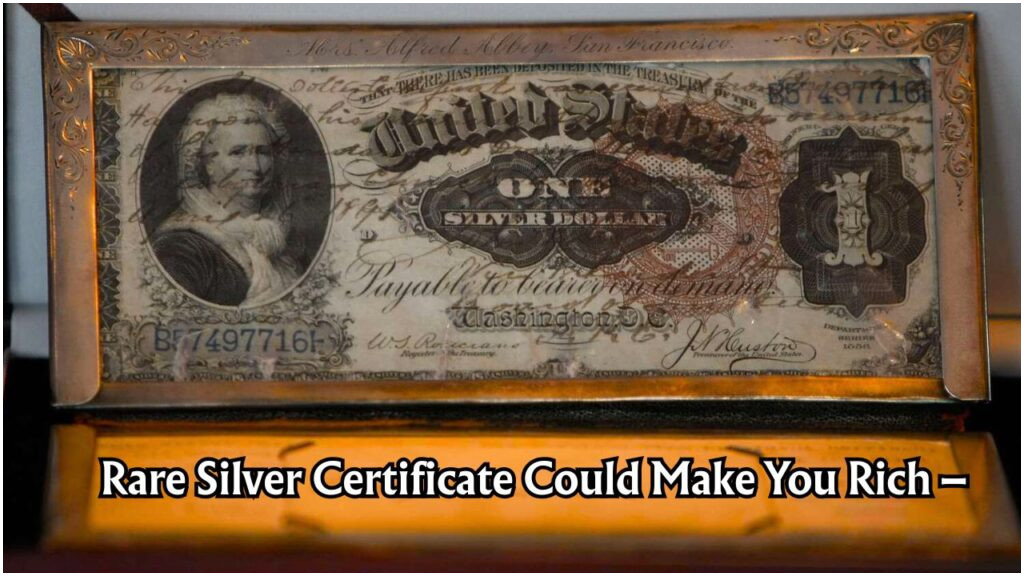
$1 Silver Certificate – In the world of rare currency collecting, even a simple $1 bill can become a goldmine—if it carries the right features. Recently, a $1 Silver Certificate stunned collectors after being auctioned for $10,000, not because of its age alone, but due to its “fancy serial number.” This has reignited interest among everyday people to check their old bills, wallets, and drawers for similar hidden treasures. But what exactly is a Silver Certificate? What makes a serial number “fancy”? And could your old $1 bill be worth thousands? Let’s break it all down and help you understand the magic behind this incredible valuation.
What Is a $1 Silver Certificate?
A Silver Certificate is a type of paper currency that was issued by the U.S. government starting in the late 19th century and continued until the 1960s. These certificates were once redeemable for actual silver coins or bullion, giving them significant intrinsic value.
- Issued Between: 1878 – 1964
- Denominations: Most commonly $1, but also higher values
- Key Feature: A promise from the U.S. Treasury to pay the bearer in silver on demand
Today, Silver Certificates are no longer redeemable for silver but have become hot collector’s items, especially when they feature unique traits like misprints or special serial numbers.
What Makes a Serial Number “Fancy”?
Serial numbers on paper money might look like random combinations of letters and digits—but for collectors, certain patterns are pure gold. These patterns, often called “fancy serial numbers,” make bills much rarer and more valuable.
Popular Fancy Serial Number Types:
| Fancy Serial Type | Example | Description |
|---|---|---|
| Repeater | 12341234 | First half repeats in second half |
| Radar | 12344321 | Same forward and backward |
| Solid | 77777777 | All same digit |
| Binary | 01010101 | Only two alternating digits |
| Ladder | 12345678 | Digits in perfect sequence |
| Low Serial | 00000001 | Starts from a very low number |
| Star Note | *12345678 | Issued to replace damaged bills – rare variant |
These are not just interesting—they are extremely desirable for numismatists (currency collectors), especially when found on older notes like Silver Certificates.
Why Did This Particular Note Sell for $10,000?
The recently sold $1 Silver Certificate from 1935 Series D carried a ladder serial number “12345678,” which is exceedingly rare in older notes. It was also in uncirculated (Crisp Uncirculated) condition, with no folds, tears, or discoloration.
Key Factors That Affected Its Price:
- Fancy Serial Number: “12345678” (Ladder)
- Condition: Mint or Near Mint
- Rarity of the Combination
- Historic Value: Being a Silver Certificate
- Auction Competition: Multiple bidders drove the price up
Even newer bills with such serials can fetch thousands, but on a vintage Silver Certificate, the value skyrockets.
How To Check If Your $1 Silver Certificate Is Valuable
If you have old $1 bills stashed away, pull them out now and examine them using the following checklist:
Checklist to Identify Valuable Silver Certificates
| Criteria | What to Look For |
|---|---|
| Is it a Silver Certificate? | It will say “Silver Certificate” on top |
| Series Year | Look for years like 1928, 1934, 1935, 1957 |
| Serial Number | Check for patterns like 12344321 or 00000001 |
| Star Notes | A “★” before the number indicates rarity |
| Condition | No folds, clean paper, centered printing |
A bill matching multiple criteria can easily be worth hundreds to thousands—even $10,000 or more.
Where Can You Sell or Appraise Your Silver Certificate?
If you think you have something special, don’t rush to a local store just yet. Use these trusted channels to get an accurate valuation:
- Online Auction Sites: eBay, Heritage Auctions
- Numismatic Dealers: Visit a certified currency appraiser
- Coin & Currency Shows: Attend events in your area
- Grading Services: Get it graded by PMG (Paper Money Guaranty) or PCGS
Getting your bill authenticated and graded can greatly increase its resale value.
Are Prices Still Going Up?
Yes—especially in 2025. As interest in alternative investments grows, people are looking into collectibles like rare currency, vintage coins, and error notes. Demand is surging and prices are climbing.
- A solid serial number 1957 Silver Certificate sold for $4,500 in April 2025
- A radar note from 1935 reached $6,800 in June 2025
- And now, this ladder serial from 1935D has broken the $10,000 barrier
Experts believe this is just the beginning of a bull market in collectible currency.
Everyday people are discovering that their old bills are worth way more than face value. What used to be just “old money” is now a piece of history with serious cash potential. Whether it’s a $1 Silver Certificate, a star note, or a misprinted $2 bill—look closely. You might be holding the next ten-thousand-dollar note in your hand.
FAQs About $1 Silver Certificates and Fancy Serial Numbers
Q1. What is a Silver Certificate worth if it has no fancy serial number?
A: In average condition, it’s typically worth $1.50–$5, but may go up to $20 if in excellent condition.
Q2. Are all star notes valuable?
A: Not necessarily, but star notes combined with old series and good condition can be worth hundreds.
Q3. Where can I check serial number patterns?
A: Use sites like coolserialnumbers.com or join collector forums for quick analysis.
Q4. Is grading my bill necessary before selling?
A: Yes, especially if you suspect high value—it increases trust and final sale price.
Q5. Can banks or ATMs still dispense Silver Certificates?
A: No, they were discontinued decades ago and are no longer in circulation from banks.
What makes a fancy serial number on a $1 Silver Certificate valuable?
Rarity and collector demand drive its value.
How can you determine the value of a $1 Silver Certificate?
By assessing its unique fancy serial number and market demand.
How rare are $1 Silver Certificates with fancy serial numbers?
They are uncommon and desirable among collectors, commanding high prices.
How can you identify a fancy serial number on a $1 Silver Certificate?
Look for repeating, ascending, or descending patterns in the serial number.