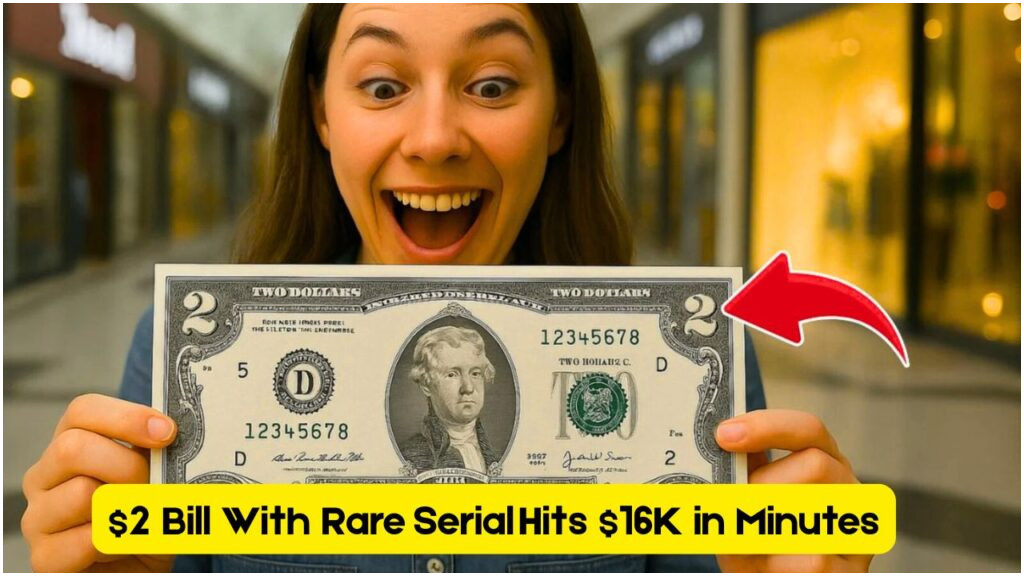
$2 Bill – In a surprising twist that has taken currency collectors and online auction platforms by storm, a rare $2 bill with a low serial number has fetched a jaw-dropping $16,000 within just minutes of being listed! This unexpected bidding war has not only shocked seasoned collectors but has also ignited widespread curiosity about the hidden value of seemingly ordinary currency lying forgotten in wallets, drawers, or family albums. If you’re wondering how a $2 bill – which most people consider uncommon but not particularly valuable – could reach such an astronomical price, you’re not alone. Let’s break down exactly why this bill was so valuable, how low serial numbers play a crucial role in currency collection, and how you too might be holding on to a small fortune without even realizing it.
What Made This $2 Bill So Special?
This particular $2 bill, listed on a collector’s auction site, featured an extremely low serial number: A00000002A. In the world of numismatics (the study or collection of currency), low serial numbers are like gold.
Currency notes with serial numbers starting with lots of zeroes – especially numbers 00000001 to 00000009 – are considered “single-digit” bills and are among the most prized by collectors.
In this case, the number 00000002 means this was the second note printed in its series, making it extraordinarily rare. Add to that the fact that $2 bills are no longer printed in high volumes, and you’ve got a rare gem that collectors are willing to fight over.
Why Did the Bidding Reach $16,000?
Bidding wars typically occur when multiple collectors recognize the extreme rarity and significance of a particular item. Here’s what contributed to the $16,000 price tag:
- Low Serial Number: As explained above, only a handful of bills begin with numbers like 00000001 or 00000002.
- Uncirculated Condition: The bill was reportedly in pristine, uncirculated condition, increasing its desirability.
- Historical Relevance: The note belonged to a limited batch from the 1976 series – a reissue that commemorated the U.S. Bicentennial.
- Collector Frenzy: Social media platforms like TikTok and Instagram have recently boosted the interest in rare currency, resulting in more public awareness and intense competition.
- Authentication: The bill came with a certificate of authenticity and had been graded by a professional currency grading service.
Rise in Demand for Rare $2 Bills
You might think that $2 bills are extinct, but that’s far from the truth. While they are no longer printed regularly, they are still legal tender in the U.S. However, because they are so rarely seen in circulation, many people mistake them for outdated or highly valuable bills.
Recently, the value of collectible $2 bills has surged due to:
- Social media trends showcasing high-value bills.
- Increased interest in collectible investments during times of economic uncertainty.
- Viral stories of people discovering rare bills worth thousands in their wallets.
What Should You Look for in Your Own Bills?
Not all $2 bills will sell for thousands, but some key features can make them more valuable:
| Feature | Description | Estimated Value |
|---|---|---|
| Low Serial Numbers | 00000001 – 00000009 | $5,000 – $20,000 |
| Star Notes | Marked with a star * | $100 – $2,500 |
| Older Series | Especially 1928, 1953, or 1976 | $10 – $5,000 |
| Uncirculated Condition | Crisp, no folds, no marks | Much higher value |
| Unique Serial Patterns | e.g., 12345678 or 00002222 | $250 – $6,000 |
How to Sell a Rare Bill for Top Dollar
If you think you have a potentially valuable $2 bill, follow these steps:
- Do Not Spend It! – Set it aside immediately.
- Research Serial Number – Use collector sites or serial number checkers online.
- Grade the Note – Send it to a professional service like PMG or PCGS for grading.
- Join Collector Forums – Post photos and get opinions from experienced collectors.
- List it on Auction Sites – Platforms like eBay, Heritage Auctions, and Stack’s Bowers are ideal.
Real-Life Example: The $2 Bill That Shocked Everyone
The $2 bill sold recently for $16,000 was part of a private estate collection. The owner had no idea of its value and almost gave it away. Luckily, a relative with an interest in collectibles noticed the serial number and convinced them to get it graded.
It was only after listing it online that the bidding war began — within 10 minutes, the price had jumped from $200 to $5,000. Within an hour, it reached $16,000, after which the item was marked as sold to a private collector in Florida.
This incredible sale proves that treasure might be hiding in plain sight, especially in the form of old or uncommon currency. Whether it’s a low serial number, a printing error, or a historical print run, even the most mundane $2 bill could be worth thousands.
So the next time you come across a $2 bill, don’t just shrug it off. Take a closer look — because that tiny piece of paper might just be your ticket to an unexpected windfall.
FAQs About Rare $2 Bills
Q1. Are $2 bills still being printed in the U.S.?
A1. Yes, but they are printed in much smaller quantities and less frequently than other denominations.
Q2. What serial numbers are most valuable?
A2. Serial numbers like 00000001 to 00000009, patterns (e.g., 12345678), or “radar” numbers (like 12344321) are highly prized.
Q3. How do I know if my $2 bill is valuable?
A3. Look for age, condition, serial number, and any star marks. Use online tools or get a professional opinion.
Q4. Where can I sell my $2 bill?
A4. You can sell it through online auction platforms like eBay or currency-specific auction houses.
Q5. Are star notes worth more?
A5. Yes, star notes indicate a replacement note and are often rarer, increasing their value among collectors.